
Dodge Journey: Relay, transmission control
DESCRIPTION
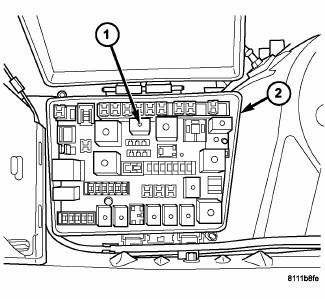
Fig. 366: Locating Transmission Control Relay
- - TRANSMISSION CONTROL RELAY
- - POWER DISTRIBUTION CENTER
The transmission control relay (1) is located in the Power Distribution Center (PDC) (2), which is located on the left side of the engine compartment between the battery and radiator upper support.
OPERATION
The Transmission Control Relay is supplied fused B+ voltage, energized by the PCM, and is used to supply power to the solenoid pack when the transmission is in normal operating mode. When the relay is "off", no power is supplied to the solenoid pack and the transmission is in "limp-in" mode. After a controller reset (ignition key turned to the "run" position or after cranking engine), the PCM energizes the relay. Prior to this, the PCM verifies that the contacts are open by checking for no voltage at the switched battery terminals. After this is verified, the voltage at the solenoid pack pressure switches is checked. After the relay is energized, the PCM monitors the terminals to verify that the voltage is greater than 3 volts.
 Pump, transmission oil
DESCRIPTION
Fig. 359: Identifying Transmission Oil Pump Assembly
- PUMP HOUSING
- OUTER PUMP GEAR
- INNER PUMP GEAR
- REACTION SHAFT SUPPORT
- SEAL RINGS (4)
- REACTION SHAFT
- CRES ...
 Seal, oil pump
REMOVAL
Fig. 367: Removing Oil Pump Seal
- SEAL PULLER C-3981-B
- OIL PUMP SEAL
1. Remove transaxle from vehicle.
2. Using Seal Puller C-3981B (1) , remove oil pump seal (2).
INSTALLA ...
See also:
Canister, vapor
Operation
All gasoline fueled vehicles use a maintenance free, evaporative (EVAP)
canister. Fuel tank vapors vent into the
canister. The canister temporarily holds the fuel vapors until intake man ...
Description
Fig. 246: Liquid/Suction Line Assembly with Rear A/C
NOTE: A/C liquid and suction line assembly with rear A/C shown. Front
A/C only line
assembly similar.
The A/C liquid line is serviced ...
Inspection
CLUTCH INSPECTION - FIXED DISPLACEMENT A/C COMPRESSOR
Fig. 212: Identifying Compressor Shaft, Clutch Plate & Shim
Examine the friction surfaces of the pulley and the clutch plate (2) for
wea ...
