
Dodge Journey: Removal, Installation
REMOVAL
WARNING: To avoid serious or fatal injury on vehicles equipped with airbags, disable the Supplemental Restraint System (SRS) before attempting any steering wheel, steering column, airbag, seat belt tensioner, impact sensor, or instrument panel component diagnosis or service. Disconnect and isolate the battery negative (ground) cable, then wait two minutes for the system capacitor to discharge before performing further diagnosis or service.
This is the only sure way to disable the SRS. Failure to take the proper precautions could result in accidental airbag deployment.
FOOT-OPERATED
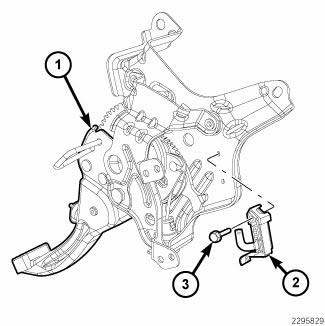
Fig. 54: Park Brake Lever Mechanism
1. Disconnect and isolate the battery negative cable.
2. Apply the parking brake.
3. Reach under the left end of the instrument panel to access and disconnect the wire harness connector from the terminal of the park brake switch (2) located on the park brake lever mechanism (1) on the left cowl side inner panel.
4. Remove the screw (3) that secures the park brake switch to the park brake lever mechanism.
5. Remove the switch from the park brake lever mechanism.
HAND-OPERATED
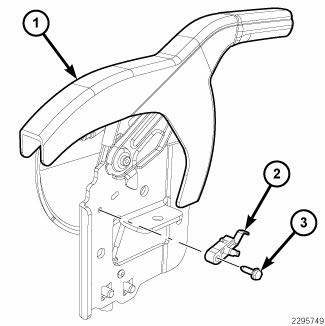
Fig. 55: Parking Brake Lever
1. Disconnect and isolate the battery negative cable.
2. Remove the console from the floor panel transmission tunnel. 3. Pull the parking brake lever (1) upward to apply the parking brake.
4. Disconnect the wire harness connector from the terminal of the park brake switch (2) located on the right side of the park brake lever mechanism.
5. Remove the screw (3) that secures the switch to the park brake lever bracket.
6. Remove the switch from the park brake lever bracket.
INSTALLATION
WARNING: To avoid serious or fatal injury on vehicles equipped with airbags, disable the Supplemental Restraint System (SRS) before attempting any steering wheel, steering column, airbag, seat belt tensioner, impact sensor, or instrument panel component diagnosis or service. Disconnect and isolate the battery negative (ground) cable, then wait two minutes for the system capacitor to discharge before performing further diagnosis or service.
This is the only sure way to disable the SRS. Failure to take the proper precautions could result in accidental airbag deployment.
FOOT-OPERATED
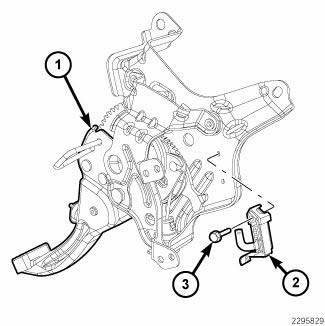
Fig. 56: Park Brake Lever Mechanism
1. Reach under the left end of the instrument panel to position the park brake switch (2) onto the park brake lever mechanism (1) on the left cowl side inner panel. Be certain to engage the locating pin on the back of the switch insulator into the locating slot in the lever mechanism bracket.
2. Install and tighten the screw (3) that secures the park brake switch to the park brake lever mechanism.
Tighten the screw to 2.5 N.m (24 in. lbs.).
3. Reconnect the wire harness connector to the terminal of the park brake switch.
4. Reconnect the battery negative cable.
5. Turn the ignition switch to the ON position and check for proper brake indicator operation with the parking brake applied, then release the parking brake and check that the brake indicator extinguishes.
HAND-OPERATED
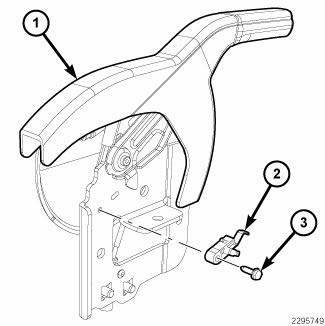
Fig. 57: Parking Brake Lever
1. Position park brake switch (2) onto the right side of the park brake lever (1) bracket. Be certain to engage the locating pin on the back of the switch insulator into the locating slot in the lever bracket.
2. Install and tighten the screw (3) that secures the switch to the lever bracket. Tighten the screw to 2.5 N.m (24 in. lbs.).
3. Reconnect the wire harness connector to the terminal of the switch.
4. Reinstall the console onto the floor panel transmission tunnel.
5. Reconnect the battery negative cable.
6. Turn the ignition switch to the ON position and check for proper brake indicator operation with the parking brake applied, then release the parking brake and check that the brake indicator extinguishes.
 Diagnosis and Testing
PARK BRAKE SWITCH
WARNING: To avoid serious or fatal injury on vehicles equipped
with airbags, disable
the Supplemental Restraint System (SRS) before attempting any steering
wheel, s ...

See also:
DEPARTMENT OF TRANSPORTATION UNIFORM TIRE QUALITY
GRADES
The following tire grading categories were established by
the National Highway Traffic Safety Administration. The
specific grade rating assigned by the tire’s manufacturer
in each category is sho ...
REPORTING SAFETY DEFECTS
In the 50 United States and Washington, D.C.
If you believe that your vehicle has a defect that could
cause a crash or cause injury or death, you should
immediately inform the National Highway Traf ...
Indicators
Indicators are located in various positions within the CCN and are all
connected to the CCN electronic circuit
board. All indicators, except the inverter indicator (if equipped), are
controlled b ...
