
Dodge Journey: Description, Operation
DESCRIPTION
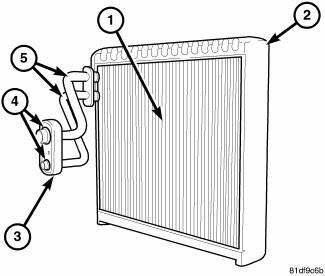
Fig. 238: Evaporator Description
NOTE: LHD model shown. RHD model similar.
The A/C evaporator (1) for the heating-A/C system is mounted in the HVAC housing, which is located behind the instrument panel. The A/C evaporator and its insulator (2) are positioned within the HVAC housing so that all air entering the housing must pass over the evaporator fins before it is distributed through the heating-A/C system ducts and outlets.
A tapping block (3) and O-ring seals (4) are used to connect and seal the A/C evaporator tubes (5) to the A/C expansion valve.
The A/C evaporator can only be serviced by removing and disassembling the HVAC housing assembly.
OPERATION
Refrigerant enters the A/C evaporator from the A/C expansion valve as a low-temperature, low-pressure mixture of liquid and gas. As air flows over the fins of the A/C evaporator, the humidity in the air condenses on the fins, and the heat from the air is absorbed by the refrigerant. Heat absorption causes the refrigerant to boil and vaporize. The refrigerant becomes a low-pressure gas when it leaves the A/C evaporator.
NOTE: Replacement of the refrigerant line O-ring seals and gaskets is required anytime a refrigerant line or expansion valve is disconnected. Failure to replace the rubber O-ring seals and metal gaskets could result in a refrigerant system leak.
The A/C evaporator has no serviceable parts except for the O-ring seals. The O-ring seals used on the connections are made from a special type of rubber not affected by R-134a refrigerant. The O-ring seals must be replaced whenever the A/C expansion valve is removed from the A/C evaporator.
The A/C evaporator cannot be repaired and must be replaced if leaking or damaged.

 Removal, Installation
REMOVAL
WARNING: Refer to the applicable warnings and cautions for this
system before
performing the following operation. Failure to follow the warnings and
cautions may result in po ...
See also:
Description, Diagnosis and Testing
Description
Fig. 17: PEDAL AND BOOSTER MOUNTING - LHD
The power brake booster (3) is mounted to the engine side of the dash panel.
The master cylinder is bolted to
the front of the booster. A v ...
Control, A/C and heater, rear
DESCRIPTION
The A/C-heater controls allows the driver and front seat passenger and the
intermediate seat passengers the
ability to regulate air temperature as well as fan speed for the rear
heat ...
Description, Operation
DESCRIPTION
The A/C refrigerant lines and hoses are used to carry the refrigerant between
the various A/C system
components. The refrigerant lines and hoses for the R-134a A/C system consist of
...
