
Dodge Journey: Actuator, blend door, rear
DESCRIPTION
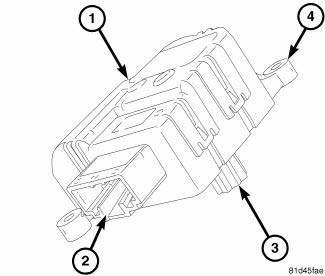
Fig. 47: Rear Actuator Description
The blend door actuator (1) for the rear heating-A/C system is a reversible, 12 volt direct current (DC), servo motor. The rear blend door actuator is located on the outboard side of the rear heater-A/C housing.
The rear blend door actuator is contained within a black molded plastic housing with an integral wire connector receptacle (2), an output shaft with splines (3) connect it to the rear blend-air door and three integral mounting tabs (4) allow the actuator to be secured to the rear heater-A/C housing. The blend door actuator does not require mechanical indexing to the blend door linkage, as it is electronically calibrated by the A/C-heater control.
The A/C-heater control must be recalibrated each time an actuator motor is replaced.
The rear blend door actuator is interchangeable with the actuator for the rear mode-air door.
OPERATION
The rear blend door actuator is connected to the A/C-heater control through the vehicle electrical system by a dedicated two-wire lead and connector of the rear heater-A/C wire harness. The rear blend door actuator can move the rear blend-air door in two directions. When the A/C-heater control pulls the voltage on one side of the motor connection high and the other connection low, the rear blend-air door will move in one direction. When the A/C-heater control reverses the polarity of the voltage to the motor, the rear blend-air door moves in the opposite direction. When the front A/C-heater control makes the voltage to both connections high or both connections low, the rear blend-air door stops and will not move.
The front A/C-heater control uses a pulse-count positioning system to monitor the operation and relative position of the rear blend door actuator and the rear blend-air door. The front A/C-heater control learns the rear blend-air door stop positions during the calibration procedure and will store a diagnostic trouble code (DTC) for any problems it detects in the rear blend door actuator circuits.
The rear blend door actuator is diagnosed using a scan tool.
The rear blend door actuator cannot be adjusted or repaired and must be replaced if inoperative or damaged.
REMOVAL
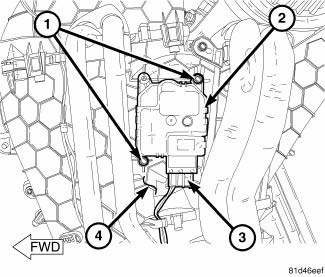
Fig. 48: Rear Blend Door Actuator Removal/Installation
1. Disconnect and isolate the negative battery cable.
2. Remove rear heater-A/C housing (4) and place it on a workbench.
3. Disconnect the wire harness connector (3) from the rear blend door actuator (2) located on the outboard side of the rear heater-A/C housing.
4. Remove the two screws (1) that secure the rear blend door actuator to the rear heater-A/C housing and remove the actuator.
INSTALLATION
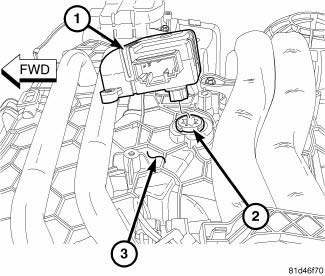
Fig. 49: Rear Blend Door Actuator Align
1. Position the rear blend door actuator (1) onto the rear heater-A/C housing (3). If necessary, rotate the actuator slightly to align the splines on the actuator output shaft with those on the rear blend-air door pivot shaft (2).
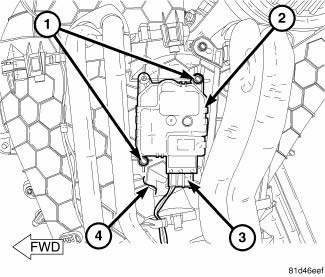
Fig. 50: Rear Blend Door Actuator Removal/Installation
2. Install the two screws (1) that secure the rear blend door actuator (2) to the rear heater-A/C housing (4).
Tighten the screws to 1.2 N.m (10 in. lbs.).
3. Connect the wire harness connector (3) to the rear blend door actuator.
4. Install the rear heater-A/C housing.
5. Initiate the Actuator Calibrationfunction using a scan tool.
 Controls, rear
...
 Actuator, mode door, rear
DESCRIPTION
Fig. 51: Rear Actuator Description
The mode door actuator (1) for the rear heater-A/C system is a reversible, 12
volt direct current (DC), servo
motor. The rear mode door actuator i ...
See also:
Diagnosis and Testing
BASE BRAKE SYSTEM
NOTE: There are three diagnosis charts following that cover the RED
BRAKE
WARNING INDICATOR LAMP, BRAKE NOISE and OTHER BRAKE CONDITIONS.
RED BRAKE WARNING INDICATOR LAMP ...
Lamp, center high mounted stop
REMOVAL
Fig. 5: Center High Mounted Stop Lamp
1. Disconnect and isolate the battery negative cable.
2. Remove the two screws (4) that secure the Center High Mounted Stop Lamp (CHMSL)
(3) to t ...
Unit, heater
DESCRIPTION
Fig. 323: Positive Temperature Coefficient Heater - Description
NOTE: LHD model shown. RHD model similar.
An electric positive temperature coefficient (PTC) heater unit (1) is us ...
