
Dodge Journey: Solenoid, evaporative emissions purge
Operation
During the cold start warm-up period and the hot start time delay, the PCM does not energize the solenoid.
When de-energized, no vapors are purged.
The proportional purge solenoid operates at a frequency of 200 hz and is controlled by an engine controller circuit that senses the current being applied to the proportional purge solenoid and then adjusts that current to achieve the desired purge flow. The proportional purge solenoid controls the purge rate of fuel vapors from the vapor canister and fuel tank to the engine intake manifold.
Removal
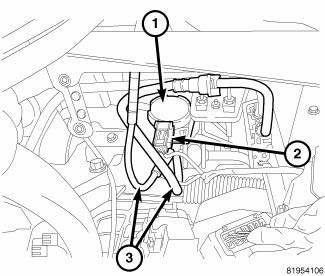
Fig. 27: PURGE SOLENOID CONNECTIONS
1. Disconnect and isolate negative battery cable at battery.
2. If equipped with 2.7L or 3.5L engine, remove the PCM.
3. Disconnect electrical connector (2) from evaporator purge solenoid (1).
4. Remove purge hose and quick connect fuel tank hose (3) from evaporator purge solenoid (1).
5. Release tab to remove evaporator purge solenoid (1) from bracket.
Installation
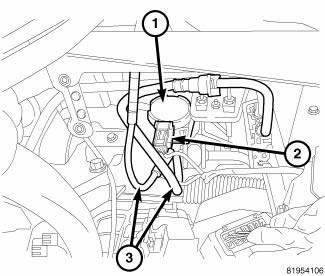
Fig. 28: PURGE SOLENOID CONNECTIONS
1. Install evaporator purge solenoid (1) to bracket. Make sure the tab secures the solenoid to the bracket.
2. Install quick connect fuel tank hose and purge hose (3) to evaporator purge solenoid (1).
3. Connect electrical connector (2) to evaporator purge solenoid (1).
4. If equipped with 2.7L or 3.5L engine, install the PCM.
5. Connect negative battery cable, tighten nut to 5 N.m (45 in. lbs.).
 Canister, vapor
Operation
All gasoline fueled vehicles use a maintenance free, evaporative (EVAP)
canister. Fuel tank vapors vent into the
canister. The canister temporarily holds the fuel vapors until intake man ...
 Switch, evaporative emissions system monitor
Operation
Fig. 29: Evaporative Emissions System Monitor Switch
- Intake Manifold
- Throttle Body
- Purge Solenoid
- Filter
- ESIM
- Vapor Canister
- Control Valve
- Fuel Tank
- ...
See also:
Installation
CLUTCH - FIXED DISPLACEMENT A/C COMPRESSOR
NOTE: Typical A/C compressor and clutch assembly shown in
illustrations.
Fig. 214: Clutch Coil & Snap Ring
1. Align the dowel pin on the bac ...
Installation
CAUTION: Be certain to adjust the refrigerant oil level when
servicing the A/C
refrigerant system. Failure to properly adjust the refrigerant
oil level will prevent the A/C system fro ...
Switch, backup lamp
DESCRIPTION
Fig. 43: Backup Lamp Switch
Vehicles equipped with a manual transmission (2) have a normally open,
spring-loaded plunger type backup
lamp switch (1). Vehicles with an optional elect ...
