
Dodge Journey: Description, Operation, Specifications
DESCRIPTION
NOTE: All engines use a fixed ignition timing system. Basic ignition timing is not adjustable. All spark advance is determined by the Powertrain Control Module (PCM).
The ignition system used on these engines is referred to as coil on plug. The system's four main components are the coils, crankshaft position sensor, spark plugs, and camshaft position sensors. The coil on plug ignition system utilizes an ignition coil for every cylinder. The ignition coils are mounted directly over the each spark plug.
OPERATION
The crankshaft position sensor and camshaft position sensor are hall effect devices. The camshaft position sensor and crankshaft position sensor generate square wave pulses that are inputs to the PCM. The PCM determines engine position from these sensors. The PCM calculates injector sequence and ignition timing from crankshaft AND camshaft position.
SPECIFICATIONS
FIRING ORDER
2.4L
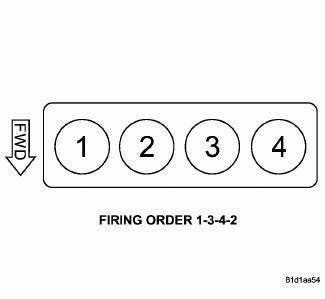
Fig. 1: Identifying Firing Order 2.4L
The firing order is 1-3-4-2.
2.7, 3.5L
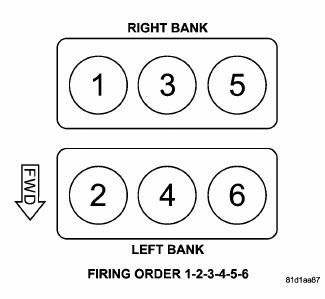
Fig. 2: Transverse 6 Cyl. Firing Order
The firing order is 1-2-3-4-5-6.
IGNITION RESISTANCE
IGNITION COIL RESISTANCE

SPARK PLUG

TORQUE
TORQUE SPECIFICATIONS
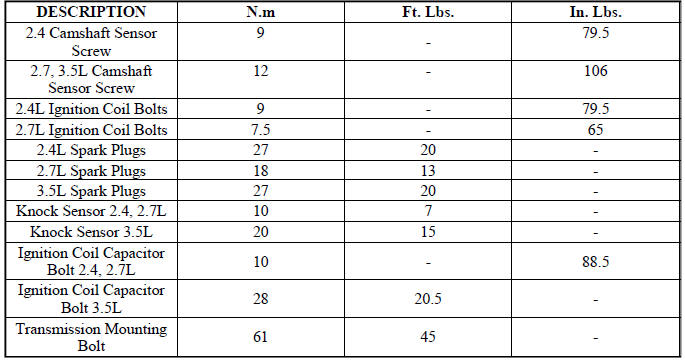
 Ignition Control
...

See also:
Manifold, exhaust, front
Removal
1. Disconnect negative battery cable.
2. Remove the engine cover.
Fig. 295: Oxygen Sensors
3. Disconnect and remove oxygen sensors (2) and (4).
Fig. 296: Upper Maniverter Heat Shiel ...
FLUIDS, LUBRICANTS, AND GENUINE PARTS
Engine
Chassis ...
Lamp, side repeater, export
REMOVAL
BULB
NOTE: Side repeater lamps are used only on vehicles manufactured for
certain export
markets where they are required.
Fig. 20: Remove/Install Repeater Lamp Bulb
1. Disconne ...
