
Dodge Journey: Description, Operation, Specifications
DESCRIPTION
NOTE: All engines use a fixed ignition timing system. Basic ignition timing is not adjustable. All spark advance is determined by the Powertrain Control Module (PCM).
The ignition system used on these engines is referred to as coil on plug. The system's four main components are the coils, crankshaft position sensor, spark plugs, and camshaft position sensors. The coil on plug ignition system utilizes an ignition coil for every cylinder. The ignition coils are mounted directly over the each spark plug.
OPERATION
The crankshaft position sensor and camshaft position sensor are hall effect devices. The camshaft position sensor and crankshaft position sensor generate square wave pulses that are inputs to the PCM. The PCM determines engine position from these sensors. The PCM calculates injector sequence and ignition timing from crankshaft AND camshaft position.
SPECIFICATIONS
FIRING ORDER
2.4L
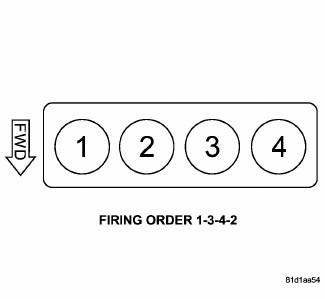
Fig. 1: Identifying Firing Order 2.4L
The firing order is 1-3-4-2.
2.7, 3.5L
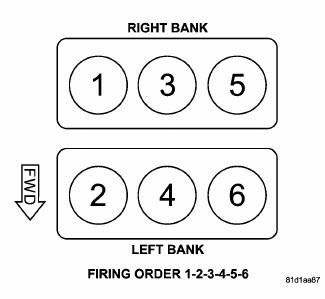
Fig. 2: Transverse 6 Cyl. Firing Order
The firing order is 1-2-3-4-5-6.
IGNITION RESISTANCE
IGNITION COIL RESISTANCE

SPARK PLUG

TORQUE
TORQUE SPECIFICATIONS
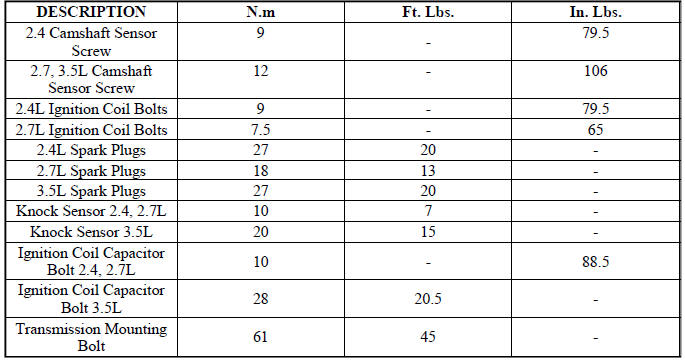
 Ignition Control
...

See also:
Motor, blower, rear
DESCRIPTION
Fig. 191: Rear Blower
The rear blower motor (1) is a 12-volt, direct current (DC) motor mounted
within a plastic housing with an
integral wire connector (4) and a squirrel cage-type ...
Removal
BEVERAGE COOLER
WARNING: Disable the airbag system before attempting any steering
wheel, steering
column, or instrument panel component diagnosis or service. Disconnect
and isolate t ...
Cap, radiator
Description
Fig. 58: Cooling System Pressure Cap
- OVERFLOW NIPPLE
- MAIN SPRING
- GASKET RETAINER
- STAINLESS-STEEL SWIVEL TOP
- RUBBER SEALS
- VENT VALVE
- COOLANT OUTLET CONNECTO ...
