
Dodge Journey: Installation
CAUTION: Be certain to adjust the refrigerant oil level when servicing the A/C refrigerant system. Failure to properly adjust the refrigerant oil level will prevent the A/C system from operating as designed and can cause serious A/C compressor damage.
NOTE: When replacing multiple A/C system components, refer to the REFRIGERANT OIL CAPACITIES to determine how much oil should be added to the refrigerant system. NOTE: If only the rear A/C evaporator is being replaced, add 30 milliliters (1 fluid ounce) of refrigerant oil to the refrigerant system. Use only refrigerant oil of the type recommended for the A/C compressor in the vehicle.
NOTE: Replacement of the refrigerant line O-ring seals is required anytime a refrigerant line or expansion valve is disconnected. Failure to replace the rubber O-ring seals could result in a refrigerant system leak.
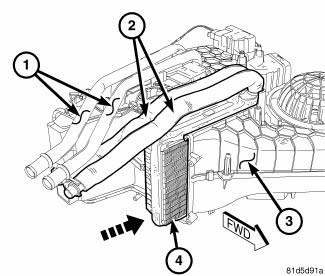
Fig. 291: Rear Evaporator Install
1. Install the rear A/C evaporator (4) into the rear heater-A/C housing (3). Guide the evaporator tubes (2) past the rear heater core tubes (1). Make sure that the foam seals are properly installed on the evaporator.
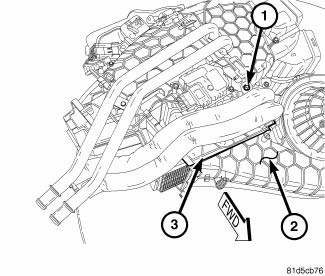
Fig. 292: Rear Evaporator Cover Removal/Installation
2. Install the evaporator cover (3) onto the outboard side of the rear heater-A/C housing (2) and install the retaining screw (1). Tighten the screw to 1.2 N.m (10 in. lbs.).
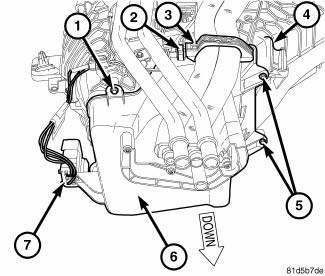
Fig. 293: Lower Rear Housing Removal/Installation
3. Install the lower rear heater-A/C housing (6) onto the rear heater-A/C housing (4). Rotate and tilt the lower housing as necessary for installation.
4. Install the five screws (1 and 5) that secure the lower housing to the rear heater-A/C housing. Tighten the screws to 1.2 N.m (10 in. lbs.).
5. Install the metal retaining clip (2) that secures the lower housing to the rear heater-A/C housing.
6. Close the evaporator tube retaining bracket (3). Make sure the bracket retainers are fully engaged.
7. Install the wire harness connector (7) onto the lower rear heater-A/C housing.
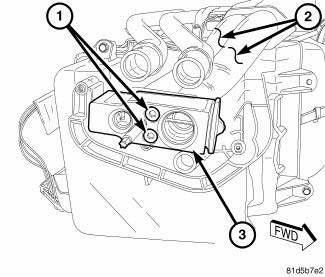
Fig. 294: Rear Expansion Valve Removal/Installation Bench
8. Remove the tape or plugs from the rear evaporator tubes and expansion valve ports.
9. Lubricate new rubber O-ring seals with clean refrigerant oil and install them onto the rear evaporator tube fittings. Use only the specified O-rings as they are made of a special material for the R-134a system. Use only refrigerant oil of the type recommended for the A/C compressor in the vehicle.
10. Install the rear A/C expansion valve (3) onto the tapping plate located on the end of the rear evaporator tubes (2) 11. Install two bolts (1) that secure the rear A/C expansion valve to the taping plate. Tighten the bolts to 11 N.m (97 in. lbs.).
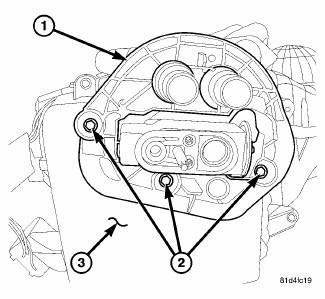
Fig. 295: Rear Housing Flange
12. Position the flange (1) to the bottom of the rear heater-A/C housing (3) and install the three retaining screws (2). Tighten the screws to 1.2 N.m (10 in. lbs.).
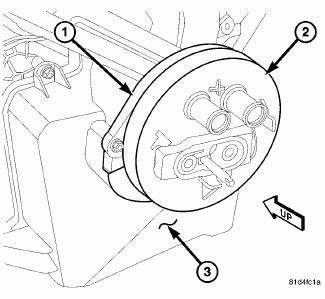
Fig. 296: Rear Housing Flange Seal
13. Install the foam seal (2) onto the flange (1) at the bottom of the rear heater-A/C housing (3). Make sure that the foam seal is properly installed.
14. Install the rear heater-A/C housing.
15. Reconnect the negative battery cable.
16. If the rear A/C evaporator is being replaced, add 30 milliliters (1 fluid ounce) of refrigerant oil to the refrigerant system. When replacing multiple A/C system components, refer to the REFRIGERANT OIL CAPACITIES to determine how much oil should be added to the refrigerant system.Use only refrigerant oil of the type recommended for the A/C compressor in the vehicle.
 Removal
WARNING: Refer to the applicable warnings and cautions for this
system before
performing the following operation. Failure to follow these instructions
may
result in serious or fat ...

See also:
Tubes and hoses, brake
DESCRIPTION
The brake tubes are steel with a corrosion-resistant nylon coating applied to
the external surfaces.
The flex hoses used at each wheel brake are made of reinforced rubber with
fitt ...
Diagnosis and Testing
BASE BRAKE SYSTEM
NOTE: There are three diagnosis charts following that cover the RED
BRAKE
WARNING INDICATOR LAMP, BRAKE NOISE and OTHER BRAKE CONDITIONS.
RED BRAKE WARNING INDICATOR LAMP ...
REMOTE STARTING SYSTEM — IF EQUIPPED
This system uses the Remote Keyless Entry (RKE) transmitter
to start the engine conveniently from outside the
vehicle while still maintaining security. The system has a
range of approximately 300 f ...
