
Dodge Journey: Specifications
BATTERY
The battery Group Size number, the Cold Cranking Amperage (CCA) rating, and the Reserve Capacity (RC) rating or Ampere-Hours (AH) rating can be found on the original equipment battery label. Be certain that a replacement battery has the correct Group Size number, as well as CCA, and RC or AH ratings that equal or exceed the original equipment specification for the vehicle being serviced. Battery sizes and ratings are discussed in more detail below.
NOTE: Vehicles equipped with a diesel engine utilize a unique battery. The specifications for this battery may differ from the standards shown in this information. Refer to the battery manufacturer for detailed specifications.
- Group Size - The outside dimensions and terminal placement of the battery conform to standards established by the Battery Council International (BCI). Each battery is assigned a BCI Group Size number to help identify a correctly-sized replacement.
- Cold Cranking Amperage - The Cold Cranking Amperage (CCA) rating specifies how much current (in amperes) the battery can deliver for thirty seconds at -18º C (0º F). Terminal voltage must not fall below 7.2 volts during or after the thirty second discharge period. The CCA required is generally higher as engine displacement increases, depending also upon the starter current draw requirements.
- Reserve Capacity - The Reserve Capacity (RC) rating specifies the time (in minutes) it takes for battery terminal voltage to fall below 10.5 volts, at a discharge rate of 25 amperes. RC is determined with the battery fully-charged at 26.7º C (80º F). This rating estimates how long the battery might last after a charging system failure, under minimum electrical load.
- Ampere-Hours - The Ampere-Hours (AH) rating specifies the current (in amperes) that a battery can deliver steadily for twenty hours, with the voltage in the battery not falling below 10.5 volts. This rating is also sometimes identified as the twenty-hour discharge rating.
- Load Test Amperage - The Load Test Amperage rating specifies the current (in amperes) that a battery should be tested at with the battery load test equipment. This value should always be 50 percent of the CCA. For example: if the CCA for this battery is 700 amps, the Load Test Amperage is 50 percent of that or 350 amps.

TORQUE
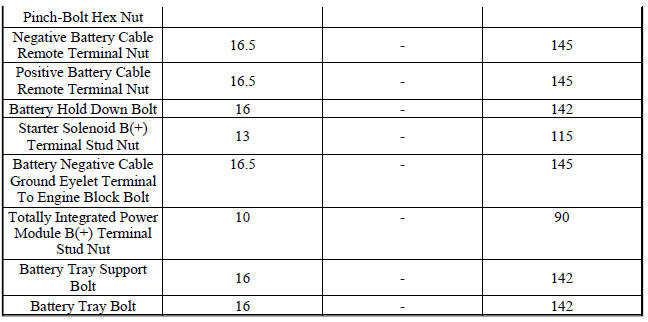
TORQUE SPECIFICATIONS

SPECIAL TOOLS
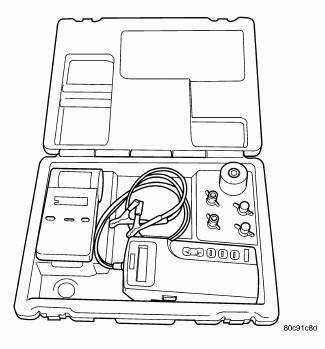
Fig. 6: Micro 420 Battery Tester - PSE p/n 165-EXP-1020KIT
 Standard procedure, Cleaning, Inspection
Standard procedure
BATTERY RECONNECTION
NOTE: This reconnection procedure is to be performed anytime the
battery has been
disconnected.
1. Connect the negative battery cable remote termin ...
 Battery
...
See also:
Heated Mirrors
DESCRIPTION
Fig. 1: Rear Window Defogger (EBL) System
NOTE: Manual tri-zone temperature A/C-heater control shown. Other
A/C-heater
controls similar.
When equipped, the heated mirror sys ...
Removal, Installation
Removal
WARNING: Refer to the applicable warnings and cautions for this
system before
performing the following operation. Failure to follow the warnings and
cautions may result in po ...
CD/DVD DISC MAINTENANCE
To keep a CD/DVD in good condition, take the following
precautions:
1. Handle the disc by its edge; avoid touching the
surface.
2. If the disc is stained, clean the surface with a soft cloth,
wip ...
