
Dodge Journey: Removal
WARNING: Refer to the applicable warnings and cautions for this system before performing the following operation. Failure to follow these instructions may result in serious or fatal injury.
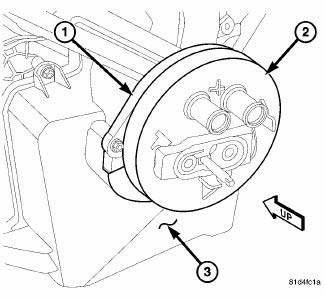
Fig. 285: Rear Housing Flange Seal
1. Disconnect and isolate the negative battery cable.
2. Remove the rear heater-A/C housing and place it on a workbench.
3. Remove the foam seal (2) from the flange (1) located at the bottom of the rear heater-A/C housing (3). If the foam seal is deformed or damaged, it must be replaced.
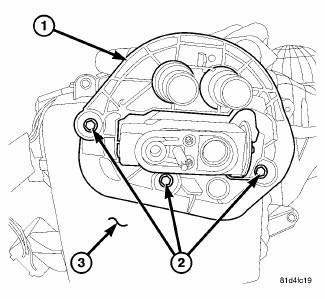
Fig. 286: Rear Housing Flange
4. Remove the three screws (2) that secure the flange (1) to the bottom of the rear heater-A/C housing (3) and remove the flange.
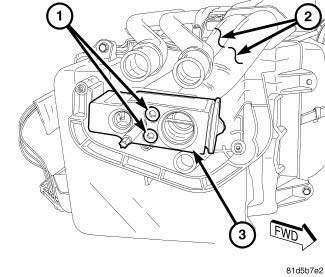
Fig. 287: Rear Expansion Valve Removal/Installation Bench
5. Remove the two screws (1) that secure the rear expansion valve (3) to the tapping plate located on the end of the rear evaporator tubes (2) and remove the valve.
6. Remove and discard the O-ring seals and install plugs in, or tape over the opened evaporator tubes and expansion valve ports.
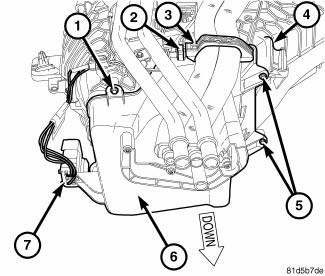
Fig. 288: Lower Rear Housing Removal/Installation
7. Remove the wire harness connector (7) from the lower rear heater-A/C housing (6).
8. Open the evaporator tube retaining bracket (3) located on the outboard side of the lower housing.
9. Remove the metal retaining clip (2) that secures the lower housing to the rear heater-A/C housing (4).
10. Remove the five screws (1 and 5) that secure the lower housing the rear heater-A/C housing and carefully remove the lower housing. Rotate and tilt the lower housing as necessary for removal.
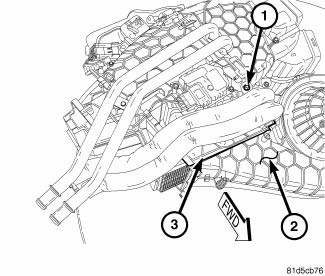
Fig. 289: Rear Evaporator Cover Removal/Installation
11. Remove the screw (1) that secures the rear evaporator cover (3) to the outboard side of the rear heater- A/C housing (2) and remove the cover of the housing.
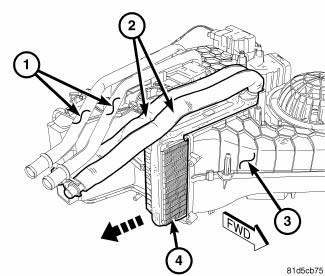
Fig. 290: Rear Evaporator Removal
12. Carefully pull the rear A/C evaporator (4) out the bottom of the rear heater-A/C housing (3). Guide the evaporator tubes (2) past the heater core tubes (1). If the foam seals on the A/C evaporator are deformed or damaged, they must be replaced.
 Description, Operation
DESCRIPTION
Fig. 284: Rear Evaporator Description
The rear A/C evaporator (4) is located within the rear heater-A/C housing,
behind the right interior quarter panel
trim. The rear A/C evaporato ...
 Installation
CAUTION: Be certain to adjust the refrigerant oil level when
servicing the A/C
refrigerant system. Failure to properly adjust the refrigerant
oil level will prevent the A/C system fro ...
See also:
Valve, A/C expansion
DESCRIPTION
Fig. 315: A/C Expansion Valve Description KA
The rear A/C expansion valve controls the amount of refrigerant entering the
rear A/C evaporator. The rear A/C
expansion valve is of a t ...
A/C Performance
The A/C system is designed to provide the passenger compartment with low
temperature and low humidity air.
The A/C evaporator, located in the HVAC housing is cooled to temperatures near
the fre ...
Installation
Fig. 137: Rear Mount Bracket
1. If transmission brackets were removed or transmission was replaced install
the rear mount bracket and
tighten (1) to 100 N.m (74 ft. lbs.).
Fig. 138: Front Mou ...
