
Dodge Journey: Removal
WARNING: Review safety precautions and warnings in this part before performing this procedure. Failure to follow the warnings and cautions could result in possible serious or fatal injury.
NOTE: LHD model shown in illustrations. RHD model similar.
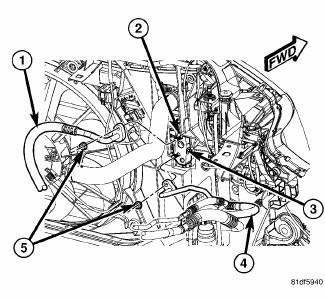
Fig. 232: Refrigerant Lines to Condenser Tapping Block
1. Disconnect and isolate the negative battery cable.
2. Recover the refrigerant from the refrigerant system.
3. Remove the nut (5) that secures the A/C liquid line (4) to the tapping block (2) located on the right side of the A/C condenser.
4. Disconnect the A/C liquid line from the tapping block and remove and discard the O-ring seal and gasket.
5. Install plugs in, or tape over the opened refrigerant line fitting and condenser port.
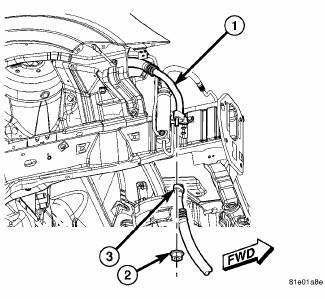
Fig. 233: Lower to Upper Suction Line
6. Raise and support the vehicle.
7. Position the front portion of the right front wheelhouse splash shield out of the way to gain access to the A/C receiver/drier.
8. Remove the nut (2) that secures the lower A/C suction line (3) to the upper A/C suction line (1).
9. Disconnect the lower A/C suction line to the upper A/C suction line and remove and discard the O-ring seal and gasket.
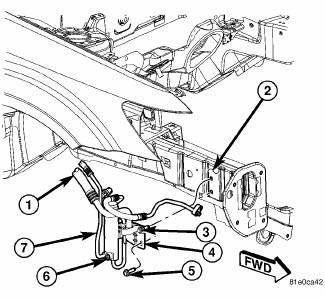
Fig. 234: Receiver/Drier Removal/Installation 09
NOTE: Illustration shown with front fascia and headlamp removed for clarity.
10. Remove the bolt (3) that secures the rear section of the A/C suction line (1) to the right front frame rail (2) and position the suction line out of the way.
11. Remove the nut (6) that secures the rear section of the A/C liquid line (7) to the A/C receiver/drier (4).
12. Disconnect the rear section of the A/C liquid line from the A/C receiver/drier, remove and discard the O-ring seal and gasket and position the liquid line out of the way.
13. Remove the bolt (5) that secure the A/C receiver/drier to the right front frame rail and remove the receiver/drier.
14. Install plugs in, or tape over all of the opened refrigerant line fittings and the receiver/drier port.
 Description, Operation
DESCRIPTION
Fig. 231: Receiver/Drier Description
The A/C receiver/drier (1) stores unused refrigerant, filters the
refrigerant, helps remove moisture from the
refrigerant and retains any refrig ...
 Installation
CAUTION: Be certain to adjust the refrigerant oil level when
servicing the A/C
refrigerant system. Failure to properly adjust the refrigerant
oil level will prevent the A/C system fro ...
See also:
Removal
NOTE: The antenna cables are integrated into the body wiring
harnesses. New antenna
cables is overlaid on the body wiring harness.
SATELLITE AUDIO ONLY
1. Disconnect and isolate the batter ...
Switch, ignition
DESCRIPTION
This vehicle is equipped with a Wireless Ignition Node (WIN). The WIN, along
with the FOB with Integrated
Key (FOBIK) are the primary components of the keyless ignition system. The onl ...
Housing, coolant outlet
Removal
Fig. 78: COOLANT OUTLET CONNECTOR - 2.7L
- BOLT (2)
- BOLT (2)
- COOLANT OUTLET CONNECTOR
WARNING: Do not remove pressure cap with the system hot and under
pressure
...
