
Dodge Journey: Standard procedure, Removal
STANDARD PROCEDURE
FRONT LAMP UNIT MOISTURE CLEARING
Some occasional moisture accumulation inside a vented front lamp unit is normal and appears as a fogging on the inside of the lamp lens, similar to the fog that sometimes appears on the inside of a windshield. This condition is caused by rapidly changing temperature and humidity levels between the air internal and external to the lamp, and will usually dissipate once the temperature and humidity conditions have been allowed to stabilize. Accelerated removal of such moisture may be accomplished by activating the headlamps on HIGH beam for about 15 minutes.
However, water droplets larger than 1 millimeter (0.039 inch) in size accumulated on the inside of the lamp lens, water droplets visible on most internal lamp surfaces or large quantities of water within the lamp indicates a problem with the lamp sealing that has allowed excessive amounts of water to enter the lamp. Once such excessive moisture has entered the lamp, it will always be present and will never disappear. A lamp with permanent internal moisture should be replaced.
REMOVAL
BULBS
HEADLAMP HIGH BEAM
CAUTION: Do not contaminate the bulb glass by touching it with your fingers or by allowing it to contact other oily surfaces. Shortened bulb life will result.
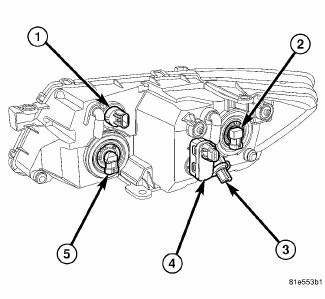
Fig. 69: Headlamp Bulb
1. Disconnect and isolate the battery negative cable.
2. Disconnect the wire harness connector from the connector receptacle integral to the headlamp bulb (5) on the back of the front lamp unit housing.
3. Firmly grasp the bulb base and rotate it counterclockwise about 30 degrees to unlock it.
4. Pull the bulb and base straight out from the keyed opening in the reflector.
HEADLAMP LOW BEAM
CAUTION: Do not contaminate the bulb glass by touching it with your fingers or by allowing it to contact other oily surfaces. Shortened bulb life will result.
1. Disconnect and isolate the battery negative cable.
2. Disconnect the wire harness connector from the connector receptacle integral to the headlamp bulb (2) on the back of the front lamp unit housing.
3. Firmly grasp the bulb base and rotate it counterclockwise about 30 degrees to unlock it.
4. Pull the bulb and base straight out from the keyed opening in the reflector.
POSITION LAMP
NOTE: The following procedure applies only to vehicles manufactured for certain export markets. Vehicles manufactured for domestic markets do not have a position lamp bulb, socket or wiring provided in the front lamp unit.
1. Disconnect and isolate the battery negative cable.
2. Disconnect the wire harness connector from the connector receptacle integral to the position lamp bulb socket (3) on the back of the front lamp unit housing.
3. Firmly grasp the position lamp bulb socket on the back of the housing and rotate it counterclockwise about 30 degrees to unlock it.
4. Pull the socket and bulb straight out from the keyed opening in the housing.
5. Pull the base of the bulb straight out of the socket.
TURN SIGNAL/SIDE MARKER LAMP
1. Disconnect and isolate the battery negative cable.
2. Disconnect the wire harness connector from the connector receptacle integral to the turn signal/side marker lamp bulb socket (1) on the back of the front lamp unit housing.
3. Firmly grasp the turn signal/side marker lamp bulb socket on the back of the housing and rotate it counterclockwise about 30 degrees to unlock it.
4. Pull the socket and bulb straight out from the keyed opening in the housing.
5. Pull the base of the bulb straight out of the socket.
LAMP
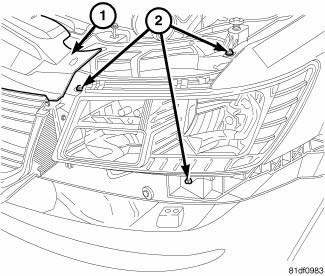
Fig. 70: Fascia & Grille
1. Disconnect and isolate the battery negative cable.
2. Loosen the front fascia on the same side of the vehicle as the front lamp unit being removed.
3. Remove the four plastic push-pin fasteners that secure the upper grille to the Front End Module (FEM).
4. Flex the fascia and grille (1) outward far enough to access and remove the three screws (2) that secure the front lamp unit to the FEM.
5. Pull the front lamp unit away from the FEM far enough to access and disconnect the headlamp and dash wire harness connectors from the back of the lamp housing.
6. Remove the front lamp unit from the vehicle.
 Unit, front lamp
...
 Installation
BULBS
HEADLAMP HIGH BEAM
CAUTION: Always use the correct bulb size and type for
replacement. An incorrect
bulb size or type may overheat and cause damage to the lamp, the socket
or ...
See also:
Inspection, adjustments
INSPECTION
Inspect the exhaust pipes, catalytic converters, muffler, and resonators for
cracked joints, broken welds and
corrosion damage that would result in a leaking exhaust system. Inspect the ...
Fan, cooling
Description
Fig. 67: COOLING SYSTEM - OVERVIEW
- WINDSHIELD WASHER RESERVOIR
- UPPER SUPPORT
- FAN SHROUD
- FAN MOTOR
- LOWER RADIATOR HOSE
The radiator fan module includes a support ...
Description
The base brake system consists of the following components:
Brake pedal
Power brake booster
Master cylinder
Brake tubes and hoses
Disc brakes (four-wheel)
Brake lamp switch
Brake fluid ...
